
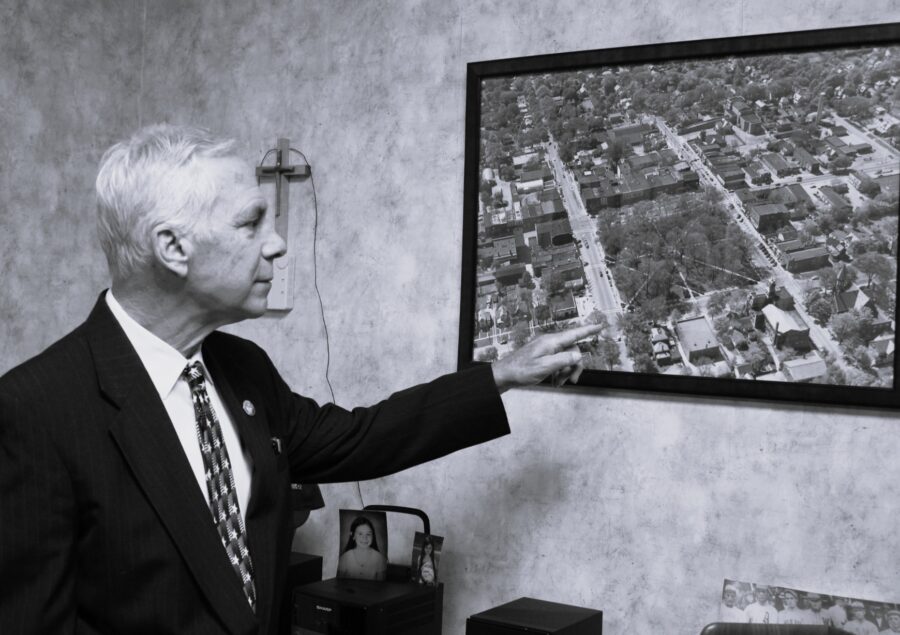
PART 1 OF 2 – Retiring Medina Mayor Dennis Hanwell looked back on his 42 years of public service to the city. In this installation, he shares some insight into his work with the Medina Police Department.
Longest serving mayor shares insights on police work
By EMILY CANNING-DEAN
Special To MedinaCountyLIVE.com
MEDINA – When Dennis Hanwell finishes his fourth term at the end of this year, he will be the longest serving mayor in Medina’s history. But Hanwell’s service to the city began decades before his days at City Hall. As he prepares for retirement, Hanwell took some time to sit down and reminisce about his 26-year career with the Medina Police Department.
After graduating from high school in Brunswick, Hanwell went on to the University of Akron where he studied police work.
“At the time, the university offered only a two-year degree for police work, so I graduated with that degree in 1977, but I couldn’t get hired anywhere as a police officer because I was only 20 and you had to be 21,” Hanwell said. “So, I worked in manufacturing until 1983 and then began to test for positions in law enforcement.”
Hanwell hired by Medina Police in 1983
Hanwell said he discussed the potential career change with his wife, Chris, before making the move because he knew leaving manufacturing for law enforcement would mean a significant pay cut, but after being hired by the Medina Police Department in 1983, Hanwell realized he made the right career choice.
“…when they ask me of all the positions I’ve had which do I like best, I say it was being a patrol officer…”Medina Mayor Dennis Hanwell
“I got on a shift with another young officer who had been hired six months before me and we were making a lot of DUI arrests and handling domestic violence cases,” he said. “I still speak at the high school and when they ask me of all the positions I’ve had which do I like best, I say it was being a patrol officer and all the opportunities I had to help and support people. But I knew I couldn’t have the same influence on patrol as I could serving in the ranks so after being a patrol officer for six years, I had the opportunity to take the test for sergeant. I was promoted and I was able to take my training and experience and help to mentor the younger officers. I did that for two years.”
Two years after his promotion to sergeant, Hanwell was promoted to patrol lieutenant, and he served in that position for five years.

During his years as lieutenant, Hanwell was in charge of all patrol shifts and came up with some innovative ways to better utilize existing personnel.
“At the time we had only two ambulances in the city,” he said. “If one was on a call working with a patient who wasn’t breathing or needed CPR, the second squad would end up getting tied up getting equipment out of the ambulance. I decided it would be a better use of our personnel to train patrol officers how to get the cot out of the ambulance, along with the backboard and the neck brace. So our patrol officers became their backup.”
Hanwell said police officers could typically arrive at the scene of an emergency faster than the ambulance, so officers were also trained to provide updates to paramedics and to gather information from patients such as the name of their doctor or the medications they were on.
“We also trained our officers to work with the fire department and how to get the fire hoses stretched out and the caps off the hydrants so by the time the firefighters had put all their gear on, they were good to go,” he said. “It’s been a model that has worked well for us. You kind of find everybody’s expertise and specialties and instead of continuing to add people, you use the existing staff more efficiently and effectively.”
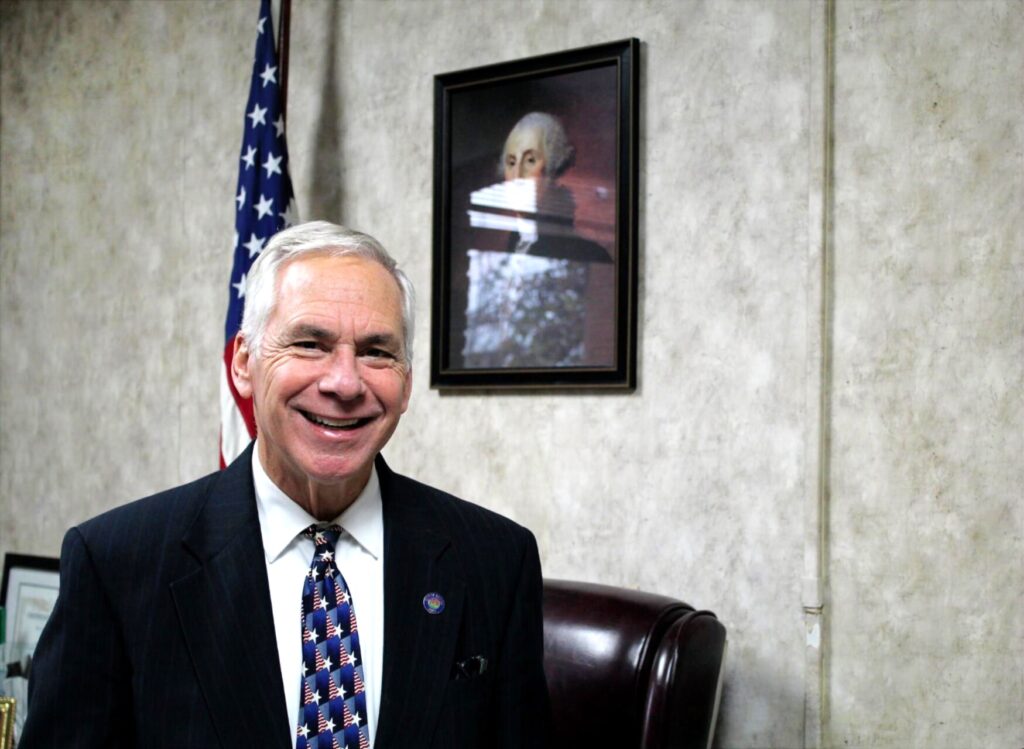
Promoted to police chief in 1996, Dennis Hanwell would display his administrative skills which would lead him to four terms as the city’s mayor. He officially set his retirement date for December 31, 2025.
Medina office trained to support and assist
Hanwell continued this model later in his career when he asked one of the city’s medics who had served as a trauma medic in the military to show Medina officers how to use a tourniquet.
“At first this training was just for the officers so that if they got a severe cut or were shot, they would be able to save their own life,” he said. “They were also trained to use something called a quick clot which can be placed on an open wound to make blood clot and stop the bleeding. But the more we were thinking about it, we decided to talk to the hospital to see if they could put together a tool kit that officers could carry which would allow them to treat eight to 10 people in the case of a mass incident.”
Hanwell said this training came in handy when a young boy was run over by a vehicle in the crosswalk of the square. When police officers arrived, they found the boy’s femoral artery had been cut and he was bleeding severely.
“It’s just about putting the right tools in the hands of the right people…”Mayor Hanwell
“The police officers got there first and got the bleeding under control and then the medics arrived and got him into trauma pants to stabilize him and then he was taken to Metro where he was operated on for six hours. But at the end, he could wiggle his toes and feel his foot because the arteries were able to be reattached,” Hanwell said. “His mom ended up carrying him into city council and said that in no other community, would he have survived.”
Hanwell said the hospital was so pleased with the results that they offered to place AEDs in the city’s police cars so that officers could assist patients if they arrived on scene before an ambulance.
Some time after placing the AEDs in the police cars, Hanwell recalls a time when a man collapsed in a local park. Officers shocked him with the AED twice before medics arrived and then medics shocked him again. Safety officials were able to send information to the main campus hospital right away and were notified to take the man directly to the helipad to be flown to the main campus instead of the local emergency room.
“It was only 50 minutes after the 911 call was made that doctors were able to put in a stent that opened up his artery,” Hanwell said. “This really isn’t rocket science. It’s just about putting the right tools in the hands of the right people and then our existing staff can accomplish so much.”
Hanwell is promoted to police chief
When Hanwell was promoted to police chief in 1996, he recalled there was a lot of grant money available for community-oriented policing, which is a priority to the Medina Police Department to this day. He took advantage of these funds in an effort to create better relationships between Medina police officers and the community.
“In essence, it’s about having the officers out in the community not just when people are being victimized, but to walk through the schools or when they have time, local shopping areas or sports fields to interact with community members in a nonconfrontational way,” Hanwell said. “They can ask people how they are doing, if they have any concerns or even what position their child plays on the soccer team.”
Hanwell said this model of community policing helps to build trust between officers and members of the city.
As police chief, Hanwell also trained officers to recognize fire code or building code violations as well as street defects that might need attention.
“The officers couldn’t enforce a code violation, but if they could recognize one, then they could call up the fire marshal or fire chief,” he said. “Or if they noticed a street defect that might break the rim on a tire, they could notify the service director, and we could get folks out there to fix the problem. I had a staff of about 35 to 38 people at the time so it was that many more eyes that could keep a lookout for the city.”
Staying loyal to City of Medina
While some law enforcement officers will transfer to police departments in other communities as they move up the ranks, Hanwell said he knew early on that he wanted to stay loyal to Medina.
“I am Type 1 diabetic, and I have been since I was five years old,” he said. “Before coming to Medina, I was interviewing with different departments, and most departments wouldn’t even talk to me when they found out I was Type 1 diabetic. But the doctor who was treating me was here in Medina and was also the doctor of the police chief at the time. I told the police chief that I would have my doctor write a letter they could review. There was a year probation for all new hires, and I asked if they would just give me a chance and they did and because of that, I decided I would never go anywhere else.”
LIVE Talk: Medina Mayor Dennis Hanwell Talks On Managing Employee Skills
AUDIO FEATURE:
Mayor Dennis Hanwell / Emily Canning-Dean
LIVE Talk is an audio feature of the Medina County Time Capsule:
Time Capsule today, a vision toward tomorrow
MedinaCountyLIVE.com is proud to be the exclusive publisher of the Medina County Time Capsule. As our nation celebrates its’ 250th celebration, we acknowledge and document the many individuals—public, private, and civic—who have helped develop our cities and townships. This online directory is a snapshot of Medina County today, with a vision toward tomorrow
